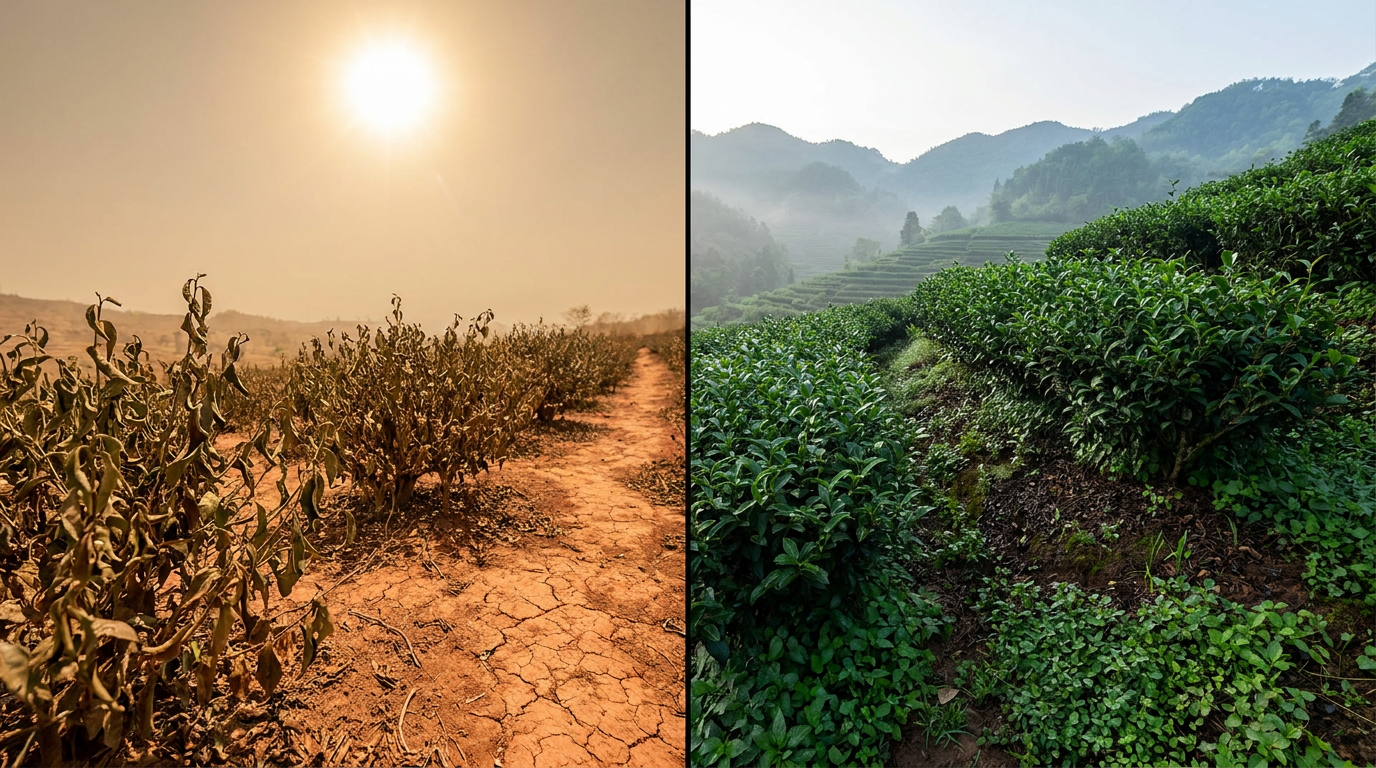
For decades, tea blenders and packagers have relied on a small group of traditional origins to anchor their portfolios. That formula is under pressure. As weather patterns shift, buyers face supply uncertainty, quality swings, and price volatility.
A 2025 peer-reviewed study projects that highly suitable growing land will decline in 11 of the world’s 20 largest tea-producing countries by 2050. Models disagree on the details, and suitability is not the same as yield, but the real-world signs are already visible.
For forward-thinking brands, the answer is not to bet on a single origin. It is to spread risk across regions, and to include high-elevation sources that are better positioned for the years ahead. Here is how the picture looks region by region.
The Global Picture: Region by Region
India (Assam): Pressure Is Already Showing
The 2025 study projects India’s highly suitable land to shrink by 0.5 to 2.2 percent by 2050, and the authors note earlier studies projecting production declines of up to 40 percent in India and Kenya. On the ground, the strain is visible. Assam produces around 650 million kilograms of tea a year, and its output fell 12 percent in June 2026 as abnormally high temperatures and a roughly 50 percent drop in seasonal rainfall hit gardens across Dibrugarh, Doomdooma, Panitola, and Tengakhat. Dry conditions also fueled red spider mite damage. The chairman of the Bharatiya Cha Parishad warned that if conditions persist, “we’re looking at one of the most challenging years in recent memory.” Industry leaders have also told the Assam Tribune that quality and production have been in steady decline, and that the state may never surpass its record 2019 output.
Kenya: A Warning for Lower-Altitude Origins
It would be a mistake to assume all of Africa is safe. The study projects Kenya could lose 2.6 to 5.5 percent of its highly suitable land by 2050, a smaller figure than some earlier models, but one that adds to the weather risk growers already face.
Sri Lanka: Steady on Paper, Volatile in Practice
The same study projects Sri Lanka’s highly suitable land to hold steady or grow slightly, by 5 to 6 percent. But weather already moves output. Production fell nearly 15 percent in April 2024 after heat and dry weather the month before, according to EconomyNext.
| Origin | Change in Highly Suitable Land by 2050 | What It Means for Buyers |
|---|---|---|
| Kenya | -2.6% to -5.5% | Lower-altitude origin under pressure |
| India | -0.5% to -2.2% | Gradual loss, with production shifting upslope |
| Sri Lanka | +5.3% to +6.4% | Modeled land holds up, real-world output still volatile |
| China | +2.0% to +2.2% | Stable in this model |
| Rwanda | +11.4% to +13.7% | Projected gain, the strongest position of these origins |
Source: Bania et al. (2025), Environmental and Sustainability Indicators. Ranges span moderate and high emissions scenarios. Selected origins. The models map land suitability, not yields.
Where Rwanda Fits
Rwandan tea grows at 5,500 to 6,500+ feet above sea level in mineral-rich volcanic soils. The 2025 study projects Rwanda’s highly suitable land growing by roughly 11 to 14 percent by 2050, and its authors note that high-altitude countries are likely to see increases. No origin is risk-free, which is why we recommend diversifying rather than relying on any single source, including ours.
What to Do Now
Waiting for a shortage means negotiating from weakness. A few practical steps:
- Qualify a second origin before you need one.
- Request samples, available for every variety and shipped directly from the garden, to test against your current origins.
- Request sack, pallet, and container quotes to compare against your current origins.
- Shift a portion of volume, even 10 to 20 percent, to diversify.
- Ask every supplier how their growing regions are exposed to climate risk and how they are adapting. Researchers point to agroforestry, drought-tolerant varieties, and micro-irrigation.
Talk to Our US-Based Team
Relying on one or two regions is no longer a safe long-term strategy, and the brands that prepare early will have the most options. If you are ready to diversify, our US-based team can send production-grade samples and provide quotes for sacks, pallets, and containers of African teas.
Sources
- Bania, J.K., Deka, J.R., Paul, A., Nath, A.J., Sileshi, G.W., Das, A.K. (2025). “Highly suitable areas for tea (Camellia sinensis) production will decline under future climate change scenarios.” Environmental and Sustainability Indicators. doi.org/10.1016/j.indic.2025.100720
- The Assam Tribune, “Crisis in a cup” (Mar 25, 2025): assamtribune.com
- Next Move Strategy Consulting, “Assam Tea Industry Faces Drought Crisis, Output Drops 12%” (Jul 25, 2026): nextmsc.com
- EconomyNext, “Sri Lanka tea production down 15-pct in April over scorching sun”: economynext.com